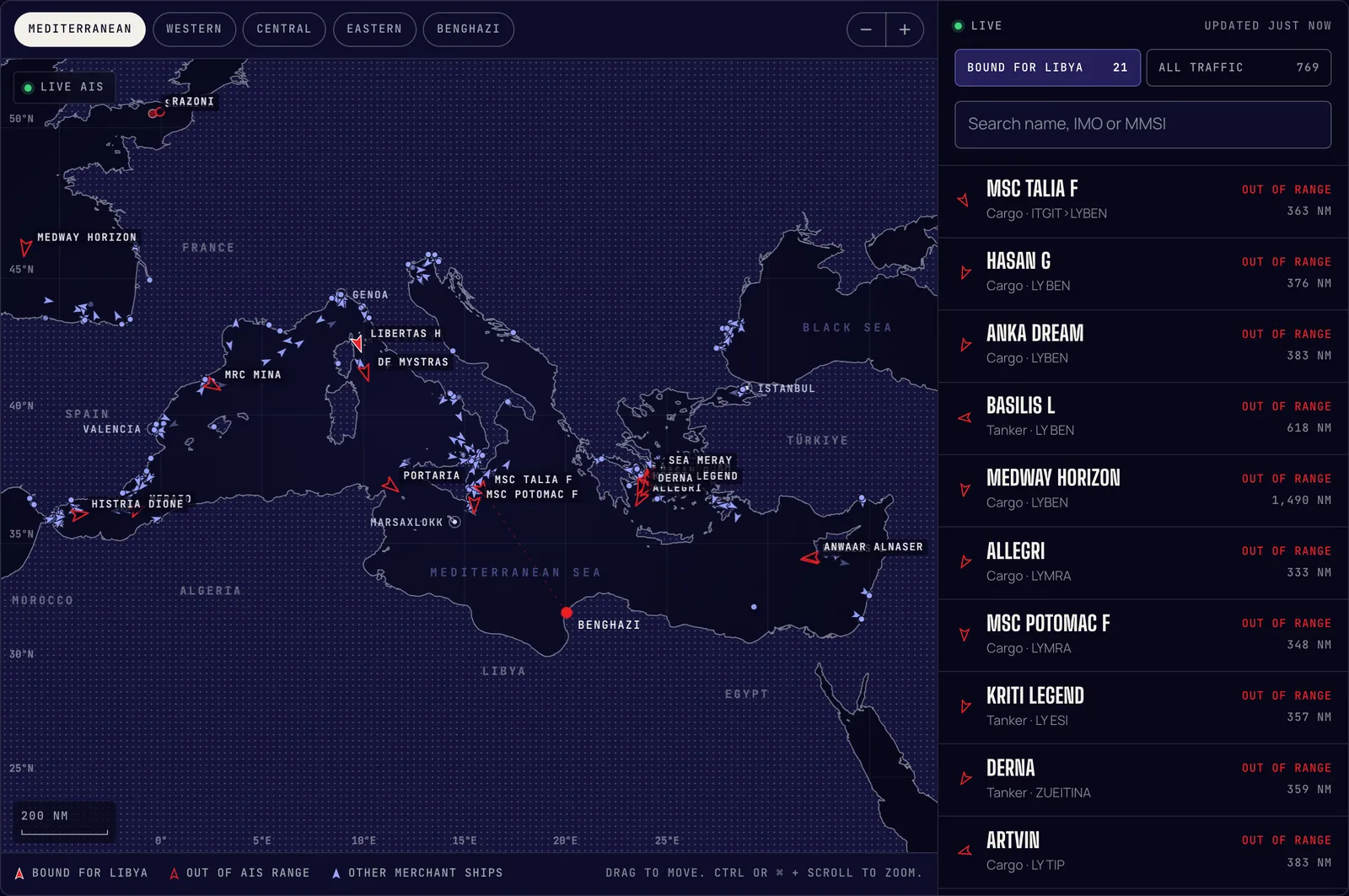
Our website now has a vessel tracking page. It charts the cargo ships and tankers crossing the Mediterranean and lists every one that is broadcasting Benghazi, or another Libyan port, as its destination. It costs nothing and needs no account, and it works on a phone.
What it shows
Each ship is drawn where it last reported its position, pointing the way it's heading. The ones bound for Libya are red, and they're listed next to the chart.
Pick a ship and you see what it's broadcasting: its name, flag, IMO and MMSI numbers, speed and course, how far it is from Benghazi, its destination and arrival time as the crew entered them, and its size and draught. The address in your browser changes to that ship, so you can send the link to a colleague and they'll open the same vessel.
You can search by name, IMO or MMSI number, and zoom from the whole Mediterranean to its western, central or eastern basin, or to the approaches to Benghazi. The page refreshes itself every minute.
Where the positions come from
Ships broadcast their position, course and speed over AIS, the Automatic Identification System, and receivers on shore pick those messages up. The chart is fed by the volunteer receivers of the AISStream network. Our server listens to them around the clock, so the list is already full when you open the page, and a ship bound for Libya stays on it for four days after it was last heard.
Why the south of the chart is quiet
A shore receiver hears a ship out to about 40 nautical miles, and the receivers in this network stand mostly on the coasts of southern Europe. None of them covers the open sea, Malta, Egypt or the Libyan coast. So a ship heading for Benghazi usually goes quiet somewhere south of Italy or Greece.
When that happens we keep it where it was last heard and draw it hollow. For a ship bound for Benghazi we also draw a dashed line for the approach it's expected to take. That line is our estimate. The ship didn't report it.
What it can't tell you
The page follows vessels. It can't tell you whether your container made it onto one, or where your goods stand in customs. For that, ask us and we'll tell you.